This image was originally intended to be a timelapse video of around 500 frames. However my lens got covered in dew after around 75 shots, so I scrapped that idea (along with 425 shots :( ) and stacked them into a star trail picture instead!
It is a stack of 75 frames, each of which is a 15sec exposure at ISO 800 on my Canon EOS 550D. Long exposure noise reduction was switched on, in the camera settings, to get rid of the dead pixels and also provide a delay between shots. Stacked and tweaked in Photoshop CS5.
The Andromeda galaxy is actually visible as a smudged trail in the top center of the image.
Showing posts with label Tim Beale. Show all posts
M3 - Globular Cluster - 01 May 2013
Here is an image of M3, a Globular
Cluster in Canes Venatici (not far from Arcturus!), discovered by Charles
Messier in 1764. It contains an estimated half million stars and is around
33,900 light years away.
The image, taken last night, is a stack of 50 1-minute
exposures at ISO800, with darks, flats and bias frames on a Canon EOS550d,
stuck on my Skywatcher 8" newtonian with a coma corrector. The whole lot
was guided using PHD and a Philips webcam. In the space of an hour I had
to scrap 5 images with Satellite trails through them, which is surprisingly
high given the small amount of sky I was looking at!
Stacked using DeepSkyStacker and processed with
CS5 following Bill's excellent Open-Cluster tutorial guide. I can probably do a
better job of this image and will try again when I have more time to fully
understand Bill's methods, but I'm pleased with it for now!The dim Galaxy in the upper right of the image is NGC5263, a Mag 13.4 spiral.
Comet Panstarrs - 27th April 2013
We finally managed to find Comet Panstarrs from the observatory pad last night, but it was very low down in the glow from Pontefract, so not easy to image!
This is a stack of 15 2-minute guided exposures using my EOS 550d DSLR on the back of a William Optics Zenithstar 80. It was visibly moving between images, so I've stacked the frames based on the comet, hence the star trails. The long 'pause' in the trails was due to a bank of cloud that graced us with its presence, but it did provide a good opportunity to get a brew on and take some darks.
I stacked it with DeepSkyStacker and very crudely processed it with CS5. I'll see if Bill can tweak some more detail out of the raw stack file on Tuesday!
This is a stack of 15 2-minute guided exposures using my EOS 550d DSLR on the back of a William Optics Zenithstar 80. It was visibly moving between images, so I've stacked the frames based on the comet, hence the star trails. The long 'pause' in the trails was due to a bank of cloud that graced us with its presence, but it did provide a good opportunity to get a brew on and take some darks.
I stacked it with DeepSkyStacker and very crudely processed it with CS5. I'll see if Bill can tweak some more detail out of the raw stack file on Tuesday!
M31 - Andromeda Galaxy
![]() |
| M31 taken from WYAS 16th Oct 2012 by Tim Beale |
It was taken from the observing pad outside WYAS using a Canon EOS550D and William Optics Zenithstar 80ED. The mount was my Skywatcher EQ5, modified with a soldering iron to hook up to a Shoestring Astronomy GPUSB adaptor and PHD Guiding. The guidescope was a butchered Skywatcher 9x50 finderscope with a Philips SPC900 webcam on the back. Quite possibly the cheapest autoguiding setup available, but very effective!
The image is a stack of twelve 2-minute exposures at ISO800, with five dark frames. Processed using DeepSkyStacker and Photoshop CS5. Very little cropping was done, which shows how large this object actually is. M32 and M110 satellite galaxies can also be seen.
On my next attempt, I will try to capture around 20-30 light frames rather than 12 and also try and get some flat frames to better balance the background.
The Transit of Venus - 6th June 2012
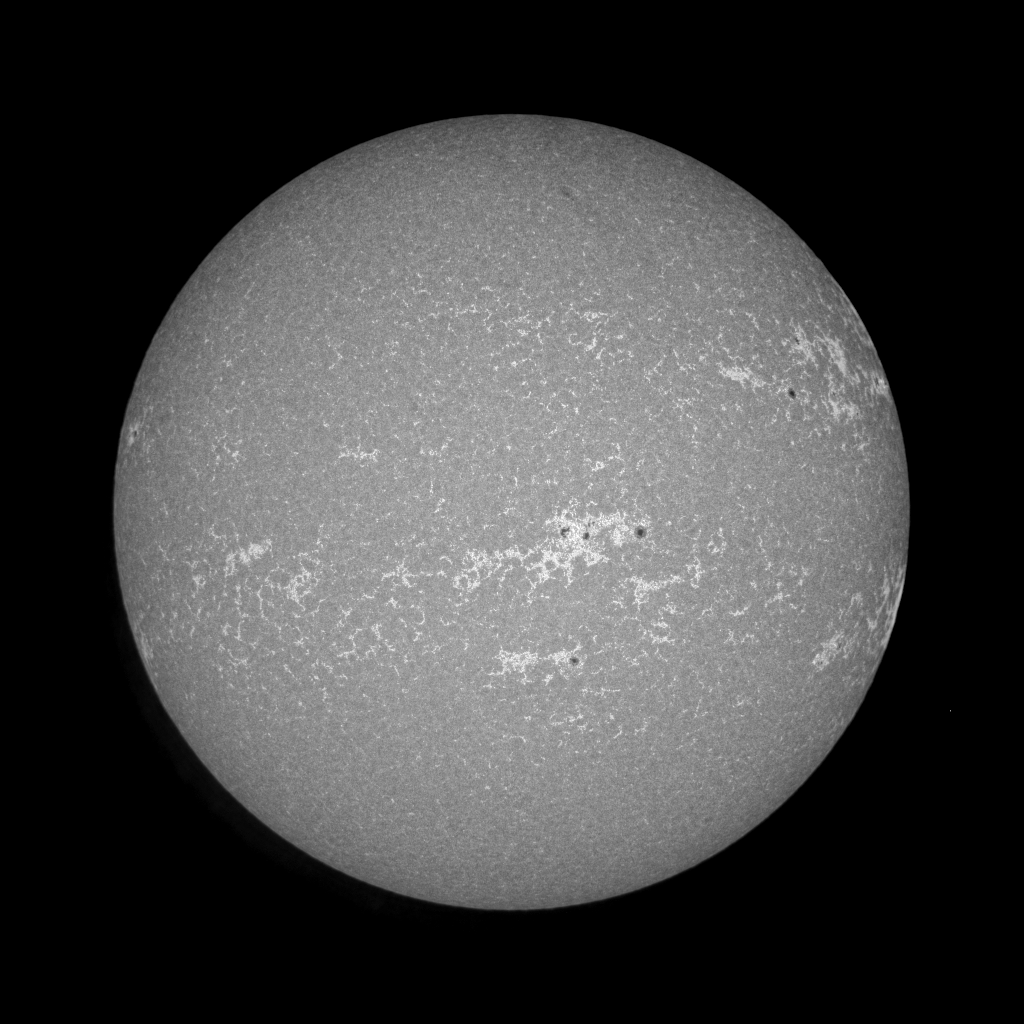
The transit of Venus as seen from Cala D'Or, Majorca at sunrise on the 6th of June 2012. I managed to find an accessible location on the rocks by the coast to view the Sun as it rose out of the sea at just past 06:20 local time (GMT +2), but, as you can see, the transit was almost over by then! Fourth contact (when Venus left the Sun's disc) was at approximately 06:55.
It was very hard to get a sharp focus with the Sun barely above the horizon but it's good enough and several Sun spot groups are visible on the disc.
The image was taken with my Canon EOS550D and WO Zenithstar 80, with a home made solar filter, mounted on a lightweight camera tripod. The exposure was 0.6 seconds at ISO 200, although, in hindsight, maybe a higher ISO and shorter exposure may have resulted in a sharper image. No image processing has been done other than a spot of cropping.
Markarian's Chain - 13/04/2012
This is an image of Markarian's Chain, which is a curved line of galaxies forming part of the Virgo galaxy cluster. It is named after the Armenian astrophysicist B. E. Markarian who identified their common motion.The galaxies include M84, M86, NGC4477, NGC 4473, NGC4461, NGC4458, NGC4438 and NGC4435. Although I can count at least 15 galaxies in the image.
I haven't identified the pasky satellite tracking through the left hand side of the shot!
The image is a stack of around 28 one minute exposures at ISO800, taken using a Canon EOS550d stuck on the back of a William Optics Zenithstar80. An IDAS LPS filter was also used. Stacking was done by DeepSkyStacker and processing by GIMP.
The Moon, Venus, Jupiter and the Winter Constellations
The image was taken with a Canon EOS550d on a tripod. Exposure was 15 seconds at f3.5, ISO 200 and a focal length of 18mm.
The Moon - 28/01/2012
M103 - Open Cluster in Cassiopeia
First light with my new William Optics Zenithstar 80 APO!!!The clouds must have spotted the new toy and moved in quickly to spoil my fun, so I only managed a single 60sec shot of this nice little cluster. At first glance, the star colours stand out much better with this refractor than photos taken through my Skywatcher reflector, in particular the Red Giant star in the middle of the cluster. Hopefully the clouds will part again soon so I can have another go!
The Moon and Venus - 27th Jan 2012
No telescope was used for this image, it's just a simple DSLR shot through a 50mm prime lens, and on a tripod of course. Darrington church is in the foreground.
Canon EOS550d, 50mm lens, ISO200, 4sec exposure at f2.8.
SN 2011fe Supernova in the Pinwheel Galaxy M101 - 21:30hrs 17/09/2011
Not the best photo I've ever taken but it was just a quick attempt at finding the Supernova in the Pinwheel Galaxy (M101) before it fades. Shining at around Mag 10, it stands out easily against the dim spiral arms and is even brighter than the central region of the galaxy.This is a Type Ia Supernova, which is an explosion of a white-dwarf star in a binary system. The Pinwheel Galaxy lies at a distance of about 23 million light years.
The image is a stack of only 3 frames (with the usual equipment) as the clouds rolled in on-cue and covered it up! Being low in the North West is also bad for me since this is the direction of Pontefract and all the sky glow that goes with it. I will return to photograph M101, minus supernova (unless there's another one!), in the Spring when it will be in a much darker area of the sky.
Comet C/2009 P1 (Garradd) - 21:00hrs, 17/09/2011
Comet Garradd is now moving from the Coathanger towards Hercules, here it is in 'no man's land' between the two. It seems to have developed a slightly more promenant tail since I last photographed it.The image is a stack of 15 30sec exposures with a Canon EOS550D and Skywatcher 200p. A coma corrector and light pollution filter were also used.
Comet C/2009 P1 (Garradd) - 23:00hrs, 01/09/2011
After passing M71 in Sagitta, Comet Garradd is now moving past Brocchi's Cluster (the Coathanger) in Vulpecula.
This is a stack of 15 jpegs straight from my camera, taken through a 70mm Televue Pronto refractor. The Coathanger is too big to fit in the field of view of my Skywatcher 200P! It's the first time I've used a refractor for astrophotography and the resulting image is by no means perfect, I seem to have blue halos around the bright stars. The frames were stacked based on the stars which means I've got slight trailing on the comet itself and shows just how fast it's moving. The total equivalent exposure time is 21 minutes.
Comet C/2009 P1 (Garradd) - 23:00hrs, 27/08/2011
This is an image of Comet Garradd passing M71 in the constellation of Sagitta. Being in the middle of the MilkyWay, the backdrop of stars really enhances the shot. M71 is the 'loose' Globular cluster in the upper left corner of the image, while the star Zeta Sge lies in the bottom right.
Taken, from my back garden, with a Canon EOS550D on a Skywatcher 200P using a coma corrector (essential for star fields like this!) and light pollution filter. It's a stack of 18 30sec frames with darks and flats, processed with DeepSkyStacker and the Gimp.
Another good photo opportunity is coming up during the first few days of September when this comet passes Brocchi's cluster, better known as the Coathanger. Stay tuned!
The Moon - 23:00 BST 14/08/2011
It may be the sworn enemy of the deep sky astronomer (me), but the Moon still makes a nice photograph!
Taken with a Canon EOS550d and Skywatcher 200P, the exposure is 1/1000sec at ISO100.
Even with no enhancement it's possible to see the different colours in the Mare, indicating different compositions of basalt. The bright rays from the crater Tycho (lower centre) show up really well when the phase is near full.
M29 - Open Cluster in Cygnus
This is M29 (also NGC 6913) in the middle of Cygnus, a nice little Open Cluster with a good background of Milky Way stars. Taken on 14th August 2011, the image is a stack of 13 30sec exposures using a Canon EOS550d on a Skywatcher 200P, a coma corrector was also used. I didn't bother with a light pollution filter as there was an almost full Moon in the sky drowning out all other sky glow! It's my first image using my newly aquired Vixen GPDX mount which is a great improvement over my other EQ5 in terms of tracking and stability. Even though it was a slightly breezy night I only had to throw away 5 shots due to non-round stars and one of those was due to a pesky satellite. The images were processed using Canon Digital Photo Professional, Deep Sky Stacker and then finished off with the Gimp.
The Leo Triplet
The Leo triplet is a group of galaxies about 35 million light years away. NGC 3628 is at the top, M66 bottom left and M65 bottom center.This image, taken on 27th April 2011, is a stack of around 20 30sec exposures using a Canon EOS550d and my Skywatcher 200P, dark and flat frames were also taken. I had to over-process the image quite a bit to bring out some of the detail in the galaxies and this has highlighted uneven illumination in the background which I can't remove, 30 second exposures aren't really long enough for this subject but my mount won't track precisely enough for any longer.
Saturn - 27th April 2011
I used Registax to produce this image from a video taken using a Canon EOS550d Digital SLR. It's a first attempt at this kind of thing for me, so plenty of room for improvement, but the image clearly shows the Cassini division in the rings, the cloud bands, and maybe, just maybe, some of those white storms in the northern cloud belt.The video output from the camera is .mov format, which Registax doesn't like, so it's a bit of a faff to convert them to uncompressed .avi, but, in true Yorkshireman fashion, I found some free software on t'internet to do the job.
I'll try and do a better job on Jupiter when it comes around in the Autumn.
M42 - The Great Orion Nebula
This image is a stack of 22 30sec. frames taken on the 8th of January 2011 using my Canon EOS550D and Skywatcher 200P, unguided. It was quite a windy evening so I had to discard about 30-40 shots due to camera shake! The RAW files from the camera were enhanced slightly and converted to 16bit TIFFs using the Canon supplied software - Digital Photo Professional. From here they were stacked using DeepSkyStacker, together with Darks and Flats and then finished off using the GIMP. I used this convoluted method because DeepSkyStacker doesn't seem to work too well with the RAW images from my camera (maybe I'm doing something wrong?) but it works very nicely with TIFFs.The center of the nebula is a bit over-exposed but all in all, quite a pleasing result....
Jupiter and Uranus - 08Jan2011
Taken with a Canon EOS 550d sat on my Skywatcher 200p. It was a 1 second exposure at ISO800.
Subscribe to:
Posts (Atom)