Showing posts with label DSLR. Show all posts

Caldwell 13 Owl Cluster and M82 Cigar Galaxy.


Both of these images were taken from my back garden in Castleford on the 28th October 2014. They are both made up of around 45 60 second exposures (ISO 1600) stacked in Deep Sky Stacker with 30 darks and 30 bias frames. Then processed in photoshop. I used a Canon 1200d SLR mounted on a Skywatcher 200PDS with a HEQ5Pro.

WYAS Moon Astrophotography Challenge 15th April 2014

As a one off challenge, we set a competition for one night to photgraph the full moon. 

This Full moon image was taken with a DSLR using an 8” SCT telescope. The image is a composite of 2 moon halves, each half being a high definition image made up of a stack of 30 DSLR images taken with 1/60th second exposure at ISO 640 with a Canon 40D.  The two halves were then merged in Photoshop.

National Astronomy Week Event 4th March 2014

WYAS held a special opening at the Rosse observatory on March 4th as part of National Astronomy Week.
The theme was “Jupiter and its moons” The event was well attended by the public and club members. We had our 14” SCT in the dome operational, plus our 18”, 10”, 8” scopes and reverse binoculars all in use by the public.
We setup astrophotography on the 8” SCT and took these images during the night of Jupiter with a Phillips SPC800 web cam and Orion using a DSLR with a 40sec exposure at ISO3200.


Sun Spots..... WYAS 40th Event 23rd November 2013

Warning.
Never look at the Sun through any Lens based device.  Telescope, Camera, Binoculars, WHY !
Looking at or near the Sun will cause instant and irreversible damage to your eye. Eye damage is often painless, so there is no warning to the observer that damage has occurred until it is too late.  Children should always have adult supervision while observing the sun.  Using special telescopes and filters that remove 99.999% of the harmful light you can observe and image the sun.
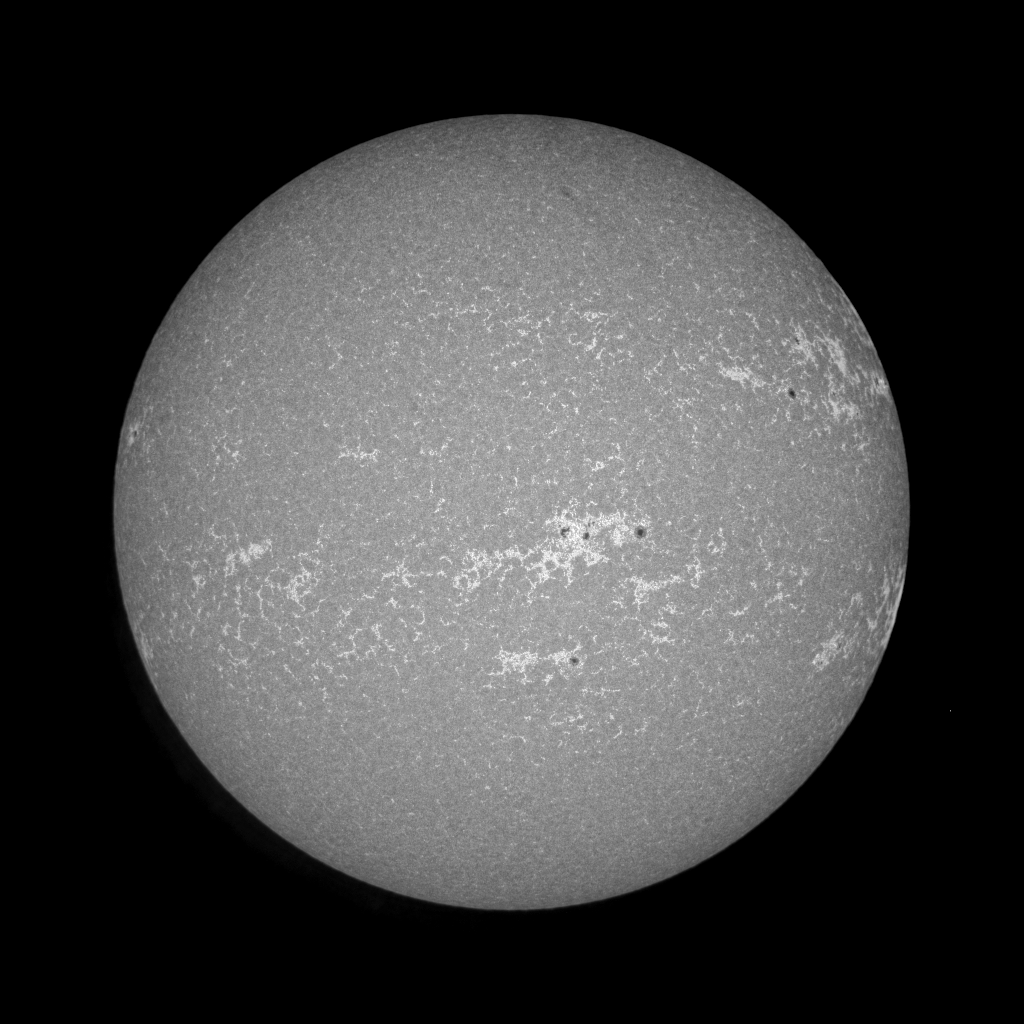
This image is a stack of 20 DSLR RAW images, taken using the WYAS Meade 10" SCT telescope with a Thousand Oaks Solar Filter and a Conon 40D. The core images were taken at 1/200 sec @ ISO 400, then stacked in RegiStax 6

Comet ISON Tuesday 19th November 2013

Comet ISON, also known  as C/2012 S1 is a sungrazing comet discovered on 21 September 2012 by Vitali Nevski, and Artyom Novichonok.  Comet ISON’s nucleus is around 5 kilometers (3.1 miles) in diameter. Comet ISON  orbit will come to perihelion (closest approach to the Sun) on 28 November 2013 at a distance of 1,860,000 km; or 1,150,000 miles from the center point of the Sun. Its trajectory appears to be hyperbolic, which suggests that it is a dynamically new comet coming freshly from the Oort Cloud. On its closest approach, Comet ISON will pass about 64,210,000 km; 39,900,000 miles from Earth on 26 December 2013.


Comet ISON/2012 S1 is expected to be brightest around the time it is closest to the Sun; however, it may be less than 1° from the Sun at its closest, making it difficult to see against the Sun's glare. In December, Comet ISON  will be growing dimmer, but, assuming that it remains intact, it will be visible from both hemispheres of Earth, possibly with a long tail. Comet ISON  will be well placed for observers in the northern hemisphere during mid to late December 2013.  After perihelion, it will move north on the celestial sphere, passing within two degrees of Polaris on 8 January.

M27 Dumbbel Nebula

The Dumbbell Nebula known as M27, is a planetary nebula in the constellation Vulpecula at a distance of about 1,360 light years from Earth. This image was taken at a WYAS open night on 2nd September 2013. This was taken using my 8" Celestron U2K SCT scope guided with a Canon 40D DSLR. This image is a stack of the best 26 images taken with a 180sec exposure at ISO 800. This image has an overall combined exposure of 78 minutes approx. Images taken in RAW were stacked using Deep Sky Stacker software to create a composite image with final image processing done in Photoshop CS6 with the aid of B McSorley.

Sun Spots (June 4th Club Night)

Warning.
Never look at the Sun through any Lens based device.  Telescope, Camera, Binoculars, WHY !
Looking at or near the Sun will cause instant and irreversible damage to your eye. Eye damage is often painless, so there is no warning to the observer that damage has occurred until it is too late.  Children should always have adult supervision while observing the sun.  If the above is the case, how do we photograph sun spots, prominences, partial / total solar eclipses ??? , by using special telescopes and filters that remove 99.999% of the harmful light thus allowing visual observation and images to be taken.
The above said, here are two images taken using an 8" SCT telescope with a Thousand Oaks Solar Filter and a normal DSLR. You can clearly see the sun spots. The images shown are stacks of 20 individual DSLR images, stacked to give the composite. The upper images were taken at 1/400 sec @ ISO 800, the lower image are 1/125 sec @ ISO 1000

PanStarrs TimeLapse 27th-28th April 2013

Panstarrs on video !  On April 27th-28th, 146 RAW DSLR images were captured using an 8" SCT on the pier at the WYAS Observatory. Collated in to a 15 second time lapse video, it shows the Panstarrs Comet moving across the sky. The comet was roughly 57° north-northwest of the Sun. in Cepheus, less than 1° east of the large emission nebula NGC 7822, also known as Cederblad 214. Because of its position, high in the northern sky, the comet will remain above the horizon all night for observers north of latitude 23° north.
(Video may not show / play on an iPad / MAC this is being resolved sorry for the inconvienence)
 

Moon 28th April 2013 02:23am ( 3 days Past Full Moon)

This is an image of the Moon taken in the early hours of Sunday 28th April at 02:23am at the WYAS observatory.

As per the image take on the 19th April, it was taken with a Celestron 8" SCT on the Large Pier with a Canon 40D DSLR. without a f6.3 reducer installed (see note below). 50 images were taken at 1/640th sec at ISO 1250 for approx. 1/2 the moon was imaged in each 50 image set (upper and lower). This is due to using the 8" SCT without the f6.3 reducer which does not give a full image of the moon within the DSLR image frame.  Each half moon image set was first stacked in RegiStax 5 using the RAW image frames. Then the stacked images was saved as 16Bit TIFF and imported in to Photoshop 6 using the MERGE option to combine the half moon images to a Full Moon image. Then it was lightly processed in Photoshop for the image as shown.

What is an f6.3 (f3.3) Focal Reducer:-
A focal reducer mounts directly to rear of a telescope and alters the field of view / focal length of the telescope for astrophotography. When an f6.3 reducer is fitted to an SCT which is normally f10 it reduces the f10 to f6.3 reducing the exposure time required to image a deep sky object. A typical 5 minutes exposure at f10 would be reduced to 3 minutes.  However, the focal length of the telescope is also reduced so the image object is reduced in size. A typical 8" SCT focal length 2000mm is reduced to 1260mm. This effectively provides a larger field of with within the DSLR image frame.  (The f3.3 does exactly the same changing an f10 to f3.3 but reducing a 2000mm focal length telescope to 660mm).

Moon Image (Just past 1st Qtr)

This is an image of the Moon taken on Friday 19th April 22:20 at the WYAS Observatory.

Taken using a Celestron 8" SCT on the Large Pier with a Canon 40D DSLR, PC connected and operated via Canon EOS for remote DSLR control. The image was also taken using a f6.3 reducer, (see note below). 50 images taken at 1/640th sec at ISO 1250. These were then stacked in RAW image format using the older RegiStax 5. The image saved as a 16bit TIFF and was then opened in PhotoShop and lightened a little to give the final image. 

What is an f6.3 (f3.3) Focal Reducer:-
A focal reducer mounts directly to rear of a telescope and alters the field of view / focal length of the telescope for astrophotography. When an f6.3 reducer is fitted to an SCT which is normally f10 it reduces the f10 to f6.3 reducing the exposure time required to image a deep sky object. A typical 5 minutes exposure at f10 would be reduced to 3 minutes.  However, the focal length of the telescope is also reduced so the image object is reduced in size. A typical 8" SCT focal length 2000mm is reduced to 1260mm. This effectively provides a larger field of with within the DSLR image frame.  (The f3.3 does exactly the same changing an f10 to f3.3 but reducing a 2000mm focal length telescope to 660mm).

The Triangulum Galaxy


The Triangulum Galaxy is a spiral galaxy approximately 3 million light years from Earth in the constellation Triangulum.  It is also known as Messier 33 or NGC 598. The Triangulum Galaxy is the third-largest member of the Local Group of galaxies, which includes the Milky Way Galaxy, the Andromeda Galaxy and about 30 other smaller galaxies. It is one of the most distant permanent objects that can be viewed without the aid of a telescope good viewing conditions with no light pollution.

This image is a combination of images taken on the 10th and 17th November using an 8" Celestron SCT with f6.3 focal reducer, guided with a QHY5 guide camera and a Canon 40D DSLR as the image camera. There are 6 images of 165sec @ ISO 1600 and 19 images 245 sec @ ISO 1250, stacked in Depp Sky Stacker and finished in Photoshop. 

M42 Orion Nebula October 7th 2012


These are updated images using my 8" Celestron SCT with guiding. It replaces and improves on an image taken in March 2012 unguided.

These image was taken on the 7th October 2012 at the WYAS observatory telescope pad, taken between 02:20am and 04:15am. It was a very clear night and not too cold.

These two images were taken with an exposure of 120 seconds using a Canon 40D DSLR, QHY5 guide camera and 50mm guidescope.

The top image is ISO 400, 12 x 120sec exposure giving a total of 24 minutes exposure.

The lower image is ISO 640, 15 x 120sec exposure giving a total of 30 minutes in total.

Images taken using a RAW format. These were processed totally in Photoshop. Opened, initially modifed to enhance the gas clouds and saved. Then using the HDR option, the images were stacked and processed for the final image. 
 

M57 Ring Nebula

The Ring Nebula appears in the northern constellation of Lyra.  It is a prominent example of a planetary nebula.  This is a shell of ionized gas expelled into the surrounding interstellar medium by a red giant star, which was passing through the last stage in its evolution before becoming a white dwarf.

This image was taken using an 8" SCT, a Canon 40D DSLR. It is a composite image of  10 x 70sec images at ISO 640 stacked in RegiStax and final processing in Photoshop.

Moon 6th October 2012

This is an image of the Moon taken at 02:10am Saturday 6th October 2012.
Taken using a Celestron 8" SCT on the Large Pier on the WYAS observatory telescope pad using a 40D Canon DSLR.
The final image is a composite of images taken at ISO 125.    4 x 1/40th sec, 32 x 1/40th sec, 44 x 1/60th sec.  each set stacked in RegiStax and then each stacked image finally stacked for the final composite.

M27 - Dumbbell Nebula

The Dumbbell Nebula also known as the Apple Core Nebula, is Messier object 27, or M 27, or NGC 6853). This is a planetary nebula in the constellation Vulpecula, and is at a distance of about 1,360 light years from Earth.

This image was taken at a WYAS open night on 19th September 2012 using one of the new piers on the Telescope pad. This was taken using my 8" Celestron U2K SCT scope unguided with a Canon 40D DSLR.

This image is a stack of the best 47 from 65 images taken. All images are 59 seconds exposure at either 800, 1200 or 1600 ISO. This image has an overall combined exposure of 46 minutes approx. Images taken in RAW were stacked using Deep Sky Stacker software to create a composite image with final image processing done in Photoshop CS5. 

Constellation Photography ( The Plough )

 While up in the Lakes District near Coniston, with a brilliant clear night of 21st September 2012, I had a go at Constellation Photography.  No tripod or remote release so I used a cushion to support the camera and the time delay function as a shutter release.   Constellation Photography can be done using a wide angle lens, long exposure with  a fast ISO with the camera ideally mounted on a tripod with remote shutter release.  This image shows part of Ursa Major (The Plough) and was taken with camera settings as below: -

Canon 1D MKII “n” with 17-28mm lens set at 17mm, wide open f2.8 and using 30 seconds exposure at ISO 1600.   I took 8 images and used DSS (Deep Sky Stacker) to stack them to give this image. Final processing is in Photoshop CS5 to give a better black /white balance.

The Transit of Venus - 6th June 2012

The transit of Venus as seen from Cala D'Or, Majorca at sunrise on the 6th of June 2012. I managed to find an accessible location on the rocks by the coast to view the Sun as it rose out of the sea at just past 06:20 local time (GMT +2), but, as you can see, the transit was almost over by then! Fourth contact (when Venus left the Sun's disc) was at approximately 06:55.
It was very hard to get a sharp focus with the Sun barely above the horizon but it's good enough and several Sun spot groups are visible on the disc.
The image was taken with my Canon EOS550D and WO Zenithstar 80, with a home made solar filter, mounted on a lightweight camera tripod. The exposure was 0.6 seconds at ISO 200, although, in hindsight, maybe a higher ISO and shorter exposure may have resulted in a sharper image. No image processing has been done other than a spot of cropping.

WYAS Telescope Pad + Orion

These two photos were taken on the evening of the 12th January 2012


A few club members opened up the dome as the viewing was excellent. Some telescopes were set up for viewing.

Using a Canon 40D DSLR with 17-25mm lens at the 17mm end with f3.5, with an exposure of 13sec @ISO 800 mounted on a tri-pod produced these two photos.

The Orion constellation can clearly be seen in the sky. Including the Orion nebula but faintly.

Orion Nebula January 23rd and March 27th 2012


The Orion Nebula also known as M42, or NGC 1976) is a diffuse nebula situated south of Orion's Belt in the constellation of Orion. It is one of the brightest nebula, and is visible to the naked eye in the night sky. M42 is located at a distance of 1,344 light years away and is the closest region of massive star formations to Earth. M42 nebula is estimated to be 24 light years across.


January 23rd 2012
This image of Orion was taken with the WYAS 14" Meade SCT.

I used my Canon 40D with an f6.3 reducer to enlarge the view area to capture the full expanse of the Nebula. The image consists of 15 out of 30, 60 second exposures taken at ISO 500. This is approx. 15 minutes exposure time.Stacked in DSS (Deep Sky Stacker), saved as a 32Bit TIF file and then final processing was done in CS5.

Final processing can adjust the tones, color and overall image to show different parts of the Nebula.

The two images to the right are the same base image file but they have been processed differently in the final CS5 processing. 

Which do you prefer??


 March 27th 2012

This image was taken at a WYAS open night on the Telescope pad.
This image is a stack of 38 x 20sec. frames @ ISO 640 using my Canon 40D on my Celestron 8" U2K SCT. This is approx. 12.6 minutes exposure time. Images taken in RAW were stacked using Deep Sky Stacker software to create a composite image with final image processing done in CS5. 
Note the overall exposure on all these images has not burnt out the star cluster in the middle of Orion. However, you can see that the blacks on the upper two images are much better than the lower image. This is partly due to the position of Orion in the sky in March and visibility in March was slightly cloudy which has not given as clear an image.   HOWEVER, it does show that you can obtain acceptable images even when seeing is not as good as it could be.