Showing posts with label Planets. Show all posts

Pluto


Taken with an ODK12 on 6.7.15. The camera was a Canon 550D at ISO800. 15 x 60sec was the exposure, all sigma-average stacked in Astroart. No guiding, no flats, no darks and no IDAS filter used. A lucky shot considering how close it was to the southern horizon. Just 11° above it among trees.
Pluto looks quite small, but then it would from here on Earth, whereas those Americans used a spacecraft to get their close-ups. Final processing in Photoshop.

Mars at Opposition


An image of Mars at Opposition, taken from the observatory pad on 15th April 2014. Stacked and processed in Registax6, then colour balanced in PixInsight. Taken with a Celestron 5se scope and a QHY5L-II camera, with a Celestron 2x Barlow.

15/4/2014

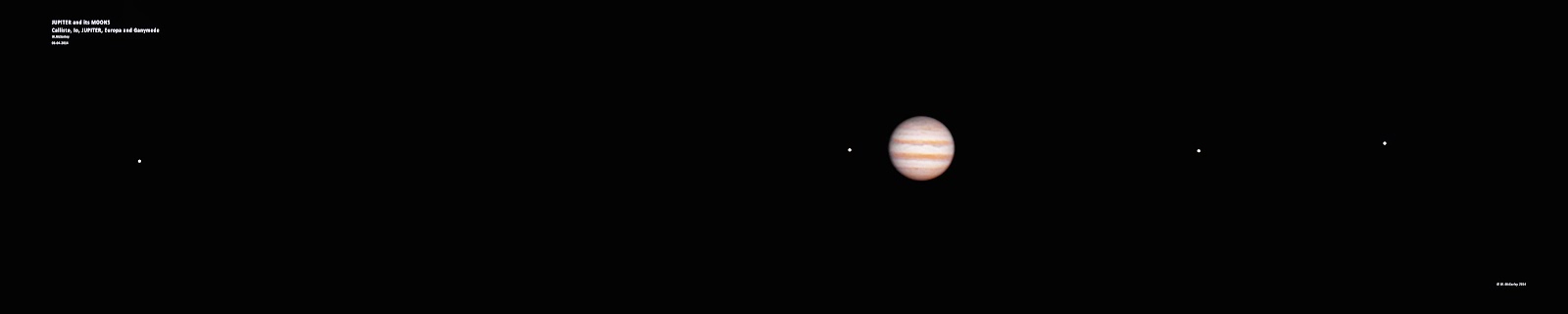
JUPITER and its MOONS


A widefield image of Jupiter and its moons (L to R: Callisto, Io, JUPITER, Europa and Ganymede) taken from the observatory pad. Stacked and processed in Registax6, then colour balanced in PixInsight.

A closeup view of Jupiter and Io.

Both images taken with a Celestron 5se scope and a QHY5L-II camera. A Celestron 2x Barlow was used for the closeup image.

8/4/2014

National Astronomy Week Event 4th March 2014

WYAS held a special opening at the Rosse observatory on March 4th as part of National Astronomy Week.
The theme was “Jupiter and its moons” The event was well attended by the public and club members. We had our 14” SCT in the dome operational, plus our 18”, 10”, 8” scopes and reverse binoculars all in use by the public.
We setup astrophotography on the 8” SCT and took these images during the night of Jupiter with a Phillips SPC800 web cam and Orion using a DSLR with a 40sec exposure at ISO3200.


Europa transit of Jupiter 29th November 2012

These images of Jupiter were taken using the 14" Meade SCT at the WYAS observatory. Seven 1500 frame .avi files were taken at 10fps and processed in Registrax 6 to create a .tif image from each .avi file. The .tif images were then finally processed in Photoshop.

The Eurpoa transit started at 19:29 and finished at 20:53 on the 29th November. These images were taken between 20:22 and 20:53.

Jupiter is the fifth planet from the Sun and is the largest planet in the Solar System. It has four Galilean moons or satellites. Transits of Jupiter happen at regular intervals and details can be found by using the  Stellarium planetarium program for your computer,
( It can be downloaded from this url   http://www.stellarium.org/ )

The Transit of Venus - 6th June 2012

The transit of Venus as seen from Cala D'Or, Majorca at sunrise on the 6th of June 2012. I managed to find an accessible location on the rocks by the coast to view the Sun as it rose out of the sea at just past 06:20 local time (GMT +2), but, as you can see, the transit was almost over by then! Fourth contact (when Venus left the Sun's disc) was at approximately 06:55.
It was very hard to get a sharp focus with the Sun barely above the horizon but it's good enough and several Sun spot groups are visible on the disc.
The image was taken with my Canon EOS550D and WO Zenithstar 80, with a home made solar filter, mounted on a lightweight camera tripod. The exposure was 0.6 seconds at ISO 200, although, in hindsight, maybe a higher ISO and shorter exposure may have resulted in a sharper image. No image processing has been done other than a spot of cropping.

New Pier, Setup and Photos 23rd May 2012

We are pleased to announce that thanks to two local companies for their help and support, WYAS have two piers currently in production for use on our telescope pad. The material for the piers has been donated by EDS Demolition from part of the material from the old Tetley's Brewery currently being demolished in Leeds. The time and manufacturing resource is being provided by Gardner Denver Ltd. The construction work on the piers in nearing completion and the first full height pier was brought to site for initial setup and positioning.  The second shorter pier should be completed in a few weeks. This will allow easy access and use for wheelchair members / visitiors and visitors from cub, scouts and guide groups. 


The pier was assembled and our 10" Meade SCT was mounted on it and used visually during the normal Tuesday meet. A web cam was mounted on the scope and the images taken are shown here. Later as the Pole Star was seen, a rough initial Polar Alignment was done so that the final pier mounting points could be marked. The pier has been returned to Gardner Denver where it will be painted and then returned for final installation.

Mars and Saturn

27th March 2012 at the WYAS open night on theTelescope Pad

Here are two photos of Mars and Saturn. Both photo's have been taken with Philips SPC800 Web Cam, 8" Celestron U2K SCT, 4x Barlow for enlarged images. The .avi files are then processed in RegiStax to give a single image and then are finally processed to enhance the image a little in CS5

These planets are viewable over the next few months weather permitting, more images should be available soon.


The Moon, Venus, Jupiter and the Winter Constellations

This image was taken on 25th March 2012 and shows the Moon, Venus and Jupiter alongside the great Winter Constellations of Orion and Taurus. In the foreground is Darrington Church.

The image was taken with a Canon EOS550d on a tripod. Exposure was 15 seconds at f3.5, ISO 200 and a focal length of 18mm.

The Moon and Venus - 27th Jan 2012

The Moon and Venus made a lovely sight in the twilight sky last night so I couldn't resist taking a picture!
No telescope was used for this image, it's just a simple DSLR shot through a 50mm prime lens, and on a tripod of course. Darrington church is in the foreground.

Canon EOS550d, 50mm lens, ISO200, 4sec exposure at f2.8.

Saturn - 27th April 2011

I used Registax to produce this image from a video taken using a Canon EOS550d Digital SLR. It's a first attempt at this kind of thing for me, so plenty of room for improvement, but the image clearly shows the Cassini division in the rings, the cloud bands, and maybe, just maybe, some of those white storms in the northern cloud belt.
The video output from the camera is .mov format, which Registax doesn't like, so it's a bit of a faff to convert them to uncompressed .avi, but, in true Yorkshireman fashion, I found some free software on t'internet to do the job.
I'll try and do a better job on Jupiter when it comes around in the Autumn.

Jupiter - 100729


This promises to be a good season for Jupiter, arching higher in the sky than the previous two.
Taken from Austerfield with an old Toucam 740 in a Vixen 260 at 3000mm EFL. Some 2000 frames were stacked in Registax and fiddled with there and in Photoshop.
The Southern Equatorial Belt continues to be absent and looks almost as though it has been "painted over". The black spot is the shadow of Ganymede.

Looking West from WYAS - 16/04/2010

The 56hr old Moon, Venus and the Pleiades (upper left of the Moon) all in a line. Mercury would have completed the line-up but I think it was hidden behind the cloud low down, I didn't see it at all on this particular evening.
Taken using a Canon EOS 550d and EF 50mm f1.8 lens, 5sec exposure at f4, ISO100.

Mercury and Venus - 7th April 2010

Mercury is currently having its best apparition of the year and can be easily found lurking next to the much brighter Venus in the early evening twilight. This picture was taken using a Canon 550d and 300mm telephoto lens, 1.6second exposure at f8, ISO400. I even managed to get a TV aerial in the shot just for Brian :)

2.3.10 - Tuesday


A couple of pictures of Mars taken from the Rosse observatory on 2.3.10, an Open Night, using the 14" Meade and a webcam. The job was done by the small group of budding astrophotographers who'd met at the observatory for the first time, and took the opportunity to take a record of Mars through the heavy haze/thin cloud. Mars was almost the only item that could get through it. The Moon came up later wearing what appeared to be a shawl.
Processing was done in Registax.