Showing posts with label Sun. Show all posts

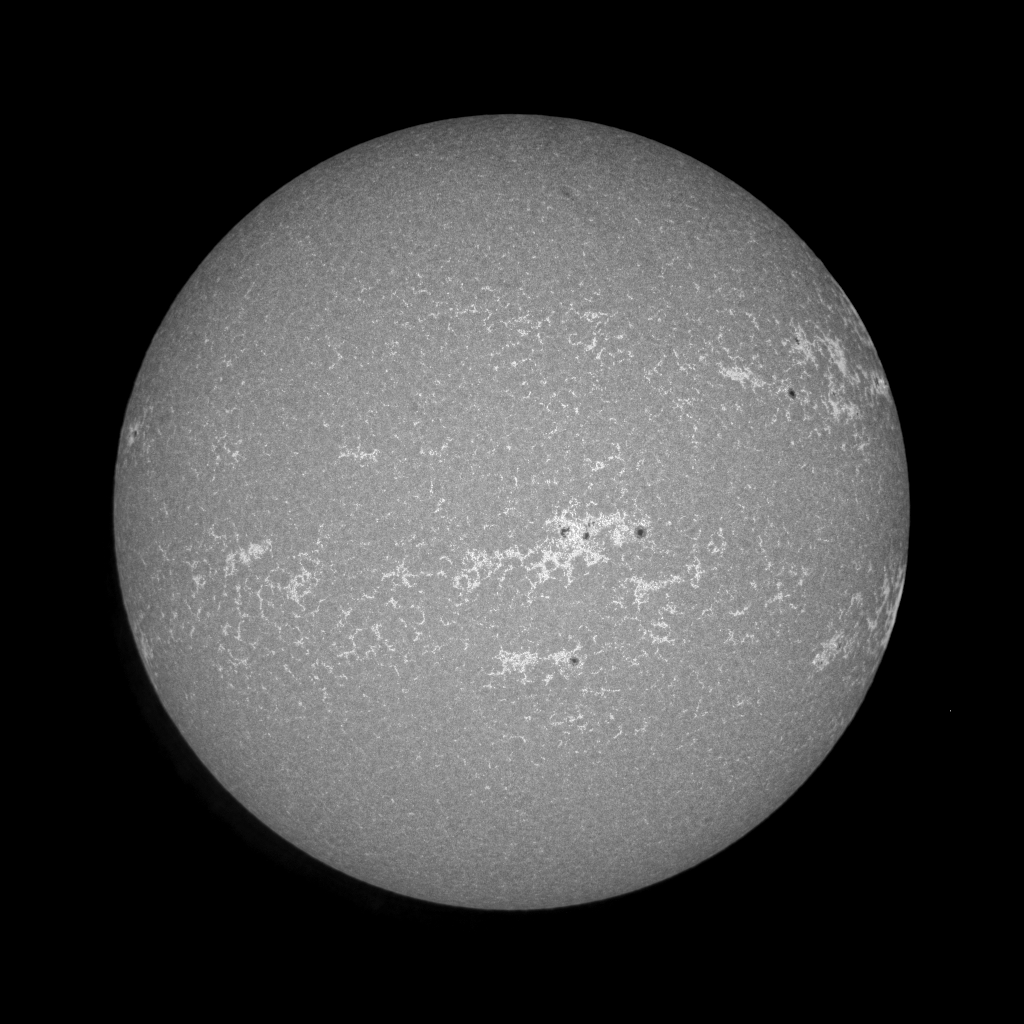
The Sun in Hydrogen-Alpha

Taken using the WYAS Tele-Vue Pronto with Coronado Solar Filters. A 4-Panel mosaic with each panel captured with a QHY5L-II Colour planetary camera running at 30fps @ 1280x960 resolution. Captured in raw SER mode, converted to AVI using PIPP, stacked and wavelet processed in Registax, then assembled in Photoshop.

 06/08/2014

Sun Spots..... WYAS 40th Event 23rd November 2013

Warning.
Never look at the Sun through any Lens based device.  Telescope, Camera, Binoculars, WHY !
Looking at or near the Sun will cause instant and irreversible damage to your eye. Eye damage is often painless, so there is no warning to the observer that damage has occurred until it is too late.  Children should always have adult supervision while observing the sun.  Using special telescopes and filters that remove 99.999% of the harmful light you can observe and image the sun.
This image is a stack of 20 DSLR RAW images, taken using the WYAS Meade 10" SCT telescope with a Thousand Oaks Solar Filter and a Conon 40D. The core images were taken at 1/200 sec @ ISO 400, then stacked in RegiStax 6

Sun Spots (June 4th Club Night)

Warning.
Never look at the Sun through any Lens based device.  Telescope, Camera, Binoculars, WHY !
Looking at or near the Sun will cause instant and irreversible damage to your eye. Eye damage is often painless, so there is no warning to the observer that damage has occurred until it is too late.  Children should always have adult supervision while observing the sun.  If the above is the case, how do we photograph sun spots, prominences, partial / total solar eclipses ??? , by using special telescopes and filters that remove 99.999% of the harmful light thus allowing visual observation and images to be taken.
The above said, here are two images taken using an 8" SCT telescope with a Thousand Oaks Solar Filter and a normal DSLR. You can clearly see the sun spots. The images shown are stacks of 20 individual DSLR images, stacked to give the composite. The upper images were taken at 1/400 sec @ ISO 800, the lower image are 1/125 sec @ ISO 1000

The Transit of Venus - 6th June 2012

The transit of Venus as seen from Cala D'Or, Majorca at sunrise on the 6th of June 2012. I managed to find an accessible location on the rocks by the coast to view the Sun as it rose out of the sea at just past 06:20 local time (GMT +2), but, as you can see, the transit was almost over by then! Fourth contact (when Venus left the Sun's disc) was at approximately 06:55.
It was very hard to get a sharp focus with the Sun barely above the horizon but it's good enough and several Sun spot groups are visible on the disc.
The image was taken with my Canon EOS550D and WO Zenithstar 80, with a home made solar filter, mounted on a lightweight camera tripod. The exposure was 0.6 seconds at ISO 200, although, in hindsight, maybe a higher ISO and shorter exposure may have resulted in a sharper image. No image processing has been done other than a spot of cropping.