Showing posts with label Bill McSorley. Show all posts

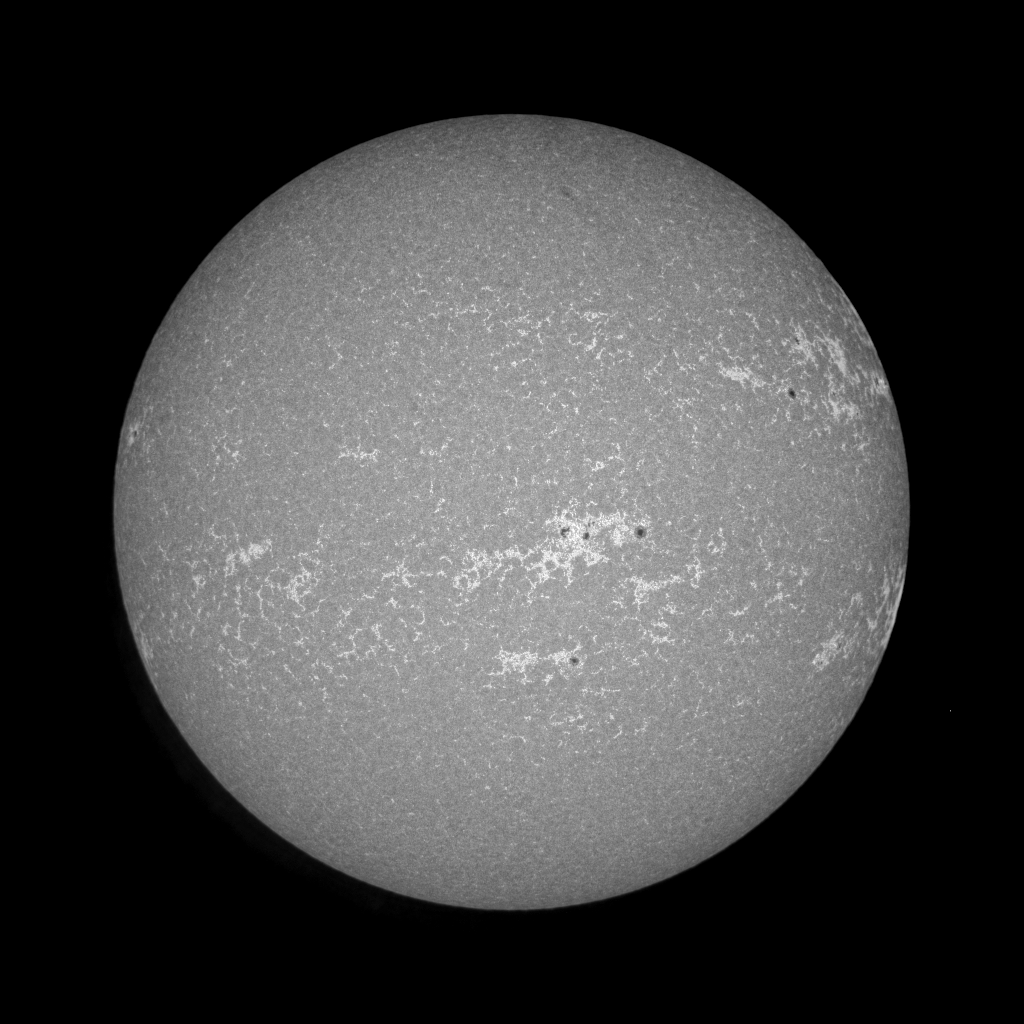
The Sun in Hydrogen-Alpha

Taken using the WYAS Tele-Vue Pronto with Coronado Solar Filters. A 4-Panel mosaic with each panel captured with a QHY5L-II Colour planetary camera running at 30fps @ 1280x960 resolution. Captured in raw SER mode, converted to AVI using PIPP, stacked and wavelet processed in Registax, then assembled in Photoshop.

 06/08/2014

Mars at Opposition


An image of Mars at Opposition, taken from the observatory pad on 15th April 2014. Stacked and processed in Registax6, then colour balanced in PixInsight. Taken with a Celestron 5se scope and a QHY5L-II camera, with a Celestron 2x Barlow.

15/4/2014

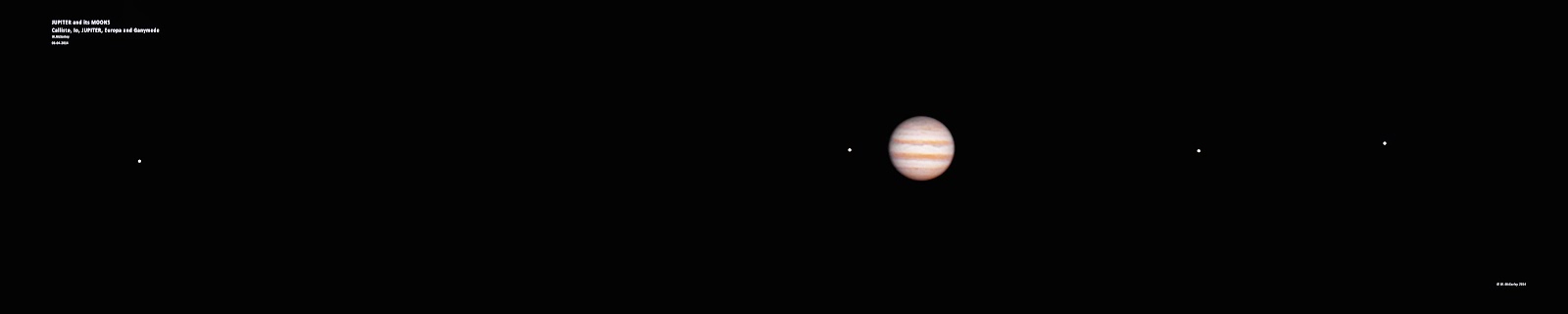
JUPITER and its MOONS


A widefield image of Jupiter and its moons (L to R: Callisto, Io, JUPITER, Europa and Ganymede) taken from the observatory pad. Stacked and processed in Registax6, then colour balanced in PixInsight.

A closeup view of Jupiter and Io.

Both images taken with a Celestron 5se scope and a QHY5L-II camera. A Celestron 2x Barlow was used for the closeup image.

8/4/2014

Messier 33 - Triangulum Galaxy


The Triangulum Galaxy is a spiral galaxy approximately 3 million light years from Earth in the constellation Triangulum. The Triangulum Galaxy is the third-largest member of our Local Group of galaxies, which includes the Milky Way, the Andromeda Galaxy and about 44 other smaller galaxies. It is one of the most distant permanent objects that can be viewed with the naked eye.

25/11/2013
36x300sec Subs, Darks, Flats and Bias

NGC7023 - The Iris Nebula

The Iris Nebula (also known as Caldwell 4) is a bright reflection nebula in the constellation Cepheus. NGC 7023 is actually the cluster within the nebula, with the nebula lit by a magnitude +7 star (SAO 19158) within the cluster. The nubula lies 1,300 light-years away and is approximately six light-years across.

27/11/2013
82x300sec Subs, Darks, Flats and Bias

The North America & Pelican Nebulae

The North America Nebula (NGC 7000) and the nearby Pelican Nebula (IC 5070) are parts of the same interstellar cloud of ionized hydrogen in the constellation Cygnus. The shape of NGC7000 resembles that of the continent of North America, complete with a prominent Gulf of Mexico and the Cygnus's Wall is the term used to describe the Mexico and Central America part of the nebula; this area being the most concentrated star formations area of the whole nebula.
These nebulae are large, covering an area of more than six times the size of the full moon, and it is estimated to be about 1800 light years distance and around 100 light years across. This image is a 3-Panel mosaic covering an area approximately 3° x 2°

27/11/2013
A 3-panel mosaic.
Each Panel: 16x300sec Subs, Darks, Flats and Bias.

Messier 31 - The Andromeda Galaxy

The Andromeda Galaxy (also known as Messier 31 or M31) is a spiral galaxy approximately 2.5 million light-years away in the constellation Andromeda. It is the nearest spiral galaxy to our own Milky Way galaxy and is the largest galaxy of our Local Group, which also contains the Milky Way, the Triangulum Galaxy, and about 30 other smaller galaxies. It is estimated that M31 contains one trillion stars, at least twice the number of stars in our own Milky Way galaxy, which is estimated to be 200–400 billion.

The Andromeda Galaxy is one of the brightest Messier objects, making it visible to the naked eye from a dark site. Although only the brighter central region is visible to the naked eye, when photographed it appears more than six times as wide as the full Moon. This image is a 2-panel mosaic covering an area approximately 2° x 2°.

4/11/2013
A 2-panel mosaic.
Each Panel: 16x300sec Subs, Darks, Flats and Bias.

The ET Cluster

The ET Cluster (NGC457) is an open star cluster in the constellation Cassiopeia and lies over 7,900 light years away from the Sun. It has an estimated age of 21 million years. The cluster is often referred to as The ET Cluster (due to its resemblance to the movie character), or The Owl Cluster. The two bright stars, magnitude 5 Phi-1 Cassiopeiae and magnitude 7 Phi-2 Cassiopeiae can be imagined as the eyes.

30/10/2013
9x300sec Subs, Darks, Flats and Bias

The Elephant's Trunk Nebula

The Elephant's Trunk is a concentration of interstellar gas and dust within the much larger ionized gas region IC 1396 located in the constellation Cepheus, about 2,400 light years away from Earth. The nebula is now thought to be a site of star formation, containing several very young stars (less than 100,000 years old) that were discovered in infrared images in 2003.

30/10/2013
25x300sec Subs, Darks, Flats and Bias

The Harvest Moon

This is a composite image. The Luminance data was captured with a QHY5L-ll planetary camera and the colour was captured by a QHY8L OSC camera. The luminance was a stack of 500 frames all stacked in Registax, whilst the colour was a stack of 64 individual images. The moon has very little colour so the colour data is enhanced sinificantly in order to show the subtle hues.

18/9/2013

Witch's Broom & Pickering's Triangle

These nebulae are part of a much bigger nebula called the Veila Super Nova Remnant. It is a cloud of heated and ionized gas and dust in Cygnus and constitutes the visible portions of the Cygnus Loop. The source supernova exploded some 5,000 to 8,000 years ago, and the remnants have since expanded to cover an area roughly 3 degrees in diameter (about 6 times the diameter, or 36 times the area, of the full moon).

7/9/2013
25x300sec Subs, Darks, Flats and Bias

M27 Dumbbel Nebula

The Dumbbell Nebula known as M27, is a planetary nebula in the constellation Vulpecula at a distance of about 1,360 light years from Earth. This image was taken at a WYAS open night on 2nd September 2013. This was taken using my 8" Celestron U2K SCT scope guided with a Canon 40D DSLR. This image is a stack of the best 26 images taken with a 180sec exposure at ISO 800. This image has an overall combined exposure of 78 minutes approx. Images taken in RAW were stacked using Deep Sky Stacker software to create a composite image with final image processing done in Photoshop CS6 with the aid of B McSorley.

M81 & M82 - Bode's and Cigar Galaxies

M81 (also known as Bode's Galaxy) is a spiral galaxy about 12 million light-years away in the constellation Ursa Major. Its companion, M82 (also known as the Cigar Galaxy) is a nearby starburst galaxy also about 12 million light-years away.

13/3/2013
20x300sec Subs, Darks, Flats and Bias.

Makarian's Chain

Makarian's Chain is a stretch of galaxies that forms part of the Virgo Cluster. It is called a chain because, when viewed from Earth, the galaxies lie along a smoothly curved line. Member galaxies include M84 and M86, plus many others.
A 2-panel mosaic.
Each panel 12x5min Subs, Darks, Flats and Bias.

M101 - Pinwheel Galaxy

The Pinwheel Galaxy (also known as NGC 5457) is a face-on spiral galaxy around 21 million light-years away in the constellation Ursa Major. M101 is a relatively large galaxy. With a diameter of 170,000 light-years, it is seventy percent larger than the Milky Way, has a disk mass on the order of 100 billion solar masses and a small bulge of about 3 billion solar masses.

27/04/2013
40x300secs Subs, Darks, Flats and Bias

Orion's Sword

Orion’s Sword is an asterism made up of NGC1973 (The Running Man Nebula), M42/M43 (The Orion Nebula) and the bright star Iota Orionis. The centrepiece, The Orion Nebula, is one of the brightest nebulae in the sky and is visible to the naked eye. The Orion Nebula is located at a distance of around 1,344 light years and is the closest region of massive star formation to Earth. It is estimated to be approximately 24 light years across, with  a mass of about 2000 times the mass of the Sun.  It is also sometimes referred to as The Great Nebula in Orion or The Great Orion Nebula.
15/01/2013
8x300secs, 8x120secs, 8x20secs Subs, Darks, Flats and Bias.

Kemble's Cascade


Kemble's Cascade is an asterism (a pattern created by unrelated stars) located in the constellation of Camelopardalis. It is an apparent straight line of more than 20 colourful 5th to 10th magnitude stars over a distance of approximately five moon diameters. It was named in honour of Father Lucian Kemble (1922–1999), a Franciscan friar and amateur astronomer who discovered it while sweeping the sky with a pair of 7x35 binoculars. He described it as "a beautiful cascade of faint stars tumbling from the northwest down to the open cluster NGC 1502".

10/12/12
A 3-panel mosaic.
Each panel 9x5min Subs, Darks, Flats and Bias.

M45 - The Pleiades


M45 - The Pleiades or Seven Sisters, is an open cluster containing middle-aged hot stars, located in the constellation of Taurus, and one of the nearest star cluster to Earth. The cluster is dominated by hot, blue and extremely luminous stars that have formed within the last 100 million years.

10/11/12
12x5min Subs, Darks, Flats and Bias

Bonfire Night Double Cluster


The Double Cluster is the common name for open clusters NGC 884 and NGC 869 in Perseus. The clusters are at distances of 7600 and 6800 light-years away, respectively, so they are also fairly close to each other in space. These are relatively young clusters, with NGC 869 being around 5.6 million years old and NGC 884 around 3.2 million years old. Unlike most other object in the Universe, these clusters are blueshifted and are approaching Earth at a speed of around 22 km/s.

5/11/12
16x5min Subs, Darks, Flats and Bias.