M27 - Dumbbell Nebula

The Dumbbell Nebula also known as the Apple Core Nebula, is Messier object 27, or M 27, or NGC 6853). This is a planetary nebula in the constellation Vulpecula, and is at a distance of about 1,360 light years from Earth.

This image was taken at a WYAS open night on 19th September 2012 using one of the new piers on the Telescope pad. This was taken using my 8" Celestron U2K SCT scope unguided with a Canon 40D DSLR.

This image is a stack of the best 47 from 65 images taken. All images are 59 seconds exposure at either 800, 1200 or 1600 ISO. This image has an overall combined exposure of 46 minutes approx. Images taken in RAW were stacked using Deep Sky Stacker software to create a composite image with final image processing done in Photoshop CS5. 

Constellation Photography ( The Plough )

 While up in the Lakes District near Coniston, with a brilliant clear night of 21st September 2012, I had a go at Constellation Photography.  No tripod or remote release so I used a cushion to support the camera and the time delay function as a shutter release.   Constellation Photography can be done using a wide angle lens, long exposure with  a fast ISO with the camera ideally mounted on a tripod with remote shutter release.  This image shows part of Ursa Major (The Plough) and was taken with camera settings as below: -

Canon 1D MKII “n” with 17-28mm lens set at 17mm, wide open f2.8 and using 30 seconds exposure at ISO 1600.   I took 8 images and used DSS (Deep Sky Stacker) to stack them to give this image. Final processing is in Photoshop CS5 to give a better black /white balance.

M27 in LRGB and Narrowband H-alpha, H-beta and OIII


The colour image of M27 was only the second time I had attempted to take images using a new imaging set-up at home. The image was taken with a Televue 102 using an Atik filter wheel containing Baader LRGB filters. 20 mins L, 15 mins R, 30 mins G and 30 mins B (all calibrated in MaximDL. Lodestar guided images.
The narrow band images were taken using the same set-up but using Baader narrowband filters 30 mins H-alpha (red), 10 mins OIII (green), 10 mins H-beta (blue). Many images taken were spoiled by strong wind.

Milky Way (Lake District)

 The Milky Way is a barred spiral galaxy 100,000–120,000 light-years in diameter containing 200–400 billion stars. The Milky Way is the galaxy that contains the Earth. This name derives from its appearance as a dim "milky" glowing band arching across the night sky, in which the naked eye cannot distinguish individual stars.  


I was up in the Lake District near Coniston on Friday 21st September, staying overnight and the weather was crystal clear. Using my Canon 1D MKII "n", I decided to try taking some Milk Way images.  Not having a tri-pod or remote release I used a cushion to support the camera pointing at the sky and used the 2 second auto-timer to activate the shutter.                                               
These images were taken using a 17mm-28mm lens set at 17mm, f2.8 (wide open) with a 30 second exposure, ISO 800.  I took 20 images and used DSS (Deep Sky Stacker) to stack these into one image. Final processing is in CS5 and hence the 3 images. All from the same base image just processed differently.

Dob finished

I have finally finished my mount , just need a crane to move it about .

Diy Dobsonian

My diy dob mount , it took around 3 hours to make with help from my Wife and daughter. I just need to paint it now .


First sun picture

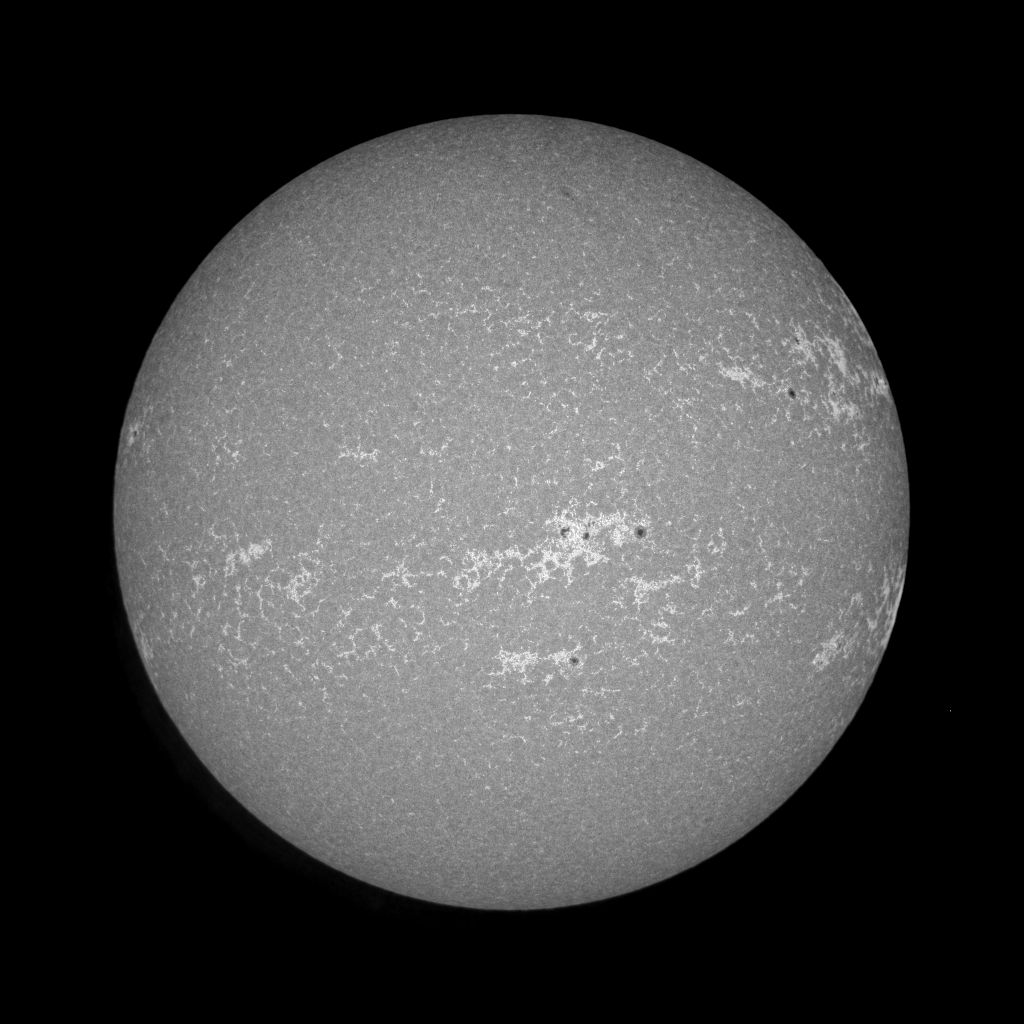
My first attempt at photographing the sun , i had to do it afocally with a small digital camera and a 20mm eyepiece . I would have done it with the webcam but i need a focal reducer because the image is way too big , next time i might try and do a mosaic . The two sunspots you see are really large hope they don`t produce a flare because its pointing straight at us lol ,we are smack in the middle of solar maximum of the suns 11 year sunspot cycle .

On my recent holiday to eygpt i had a lovely view of scorpio , shame i didn`t have a better camera you can make out the constellation if you have keen eyes .

Shall have to get a decent camera for when i go back in november .

The Transit of Venus - 6th June 2012

The transit of Venus as seen from Cala D'Or, Majorca at sunrise on the 6th of June 2012. I managed to find an accessible location on the rocks by the coast to view the Sun as it rose out of the sea at just past 06:20 local time (GMT +2), but, as you can see, the transit was almost over by then! Fourth contact (when Venus left the Sun's disc) was at approximately 06:55.
It was very hard to get a sharp focus with the Sun barely above the horizon but it's good enough and several Sun spot groups are visible on the disc.
The image was taken with my Canon EOS550D and WO Zenithstar 80, with a home made solar filter, mounted on a lightweight camera tripod. The exposure was 0.6 seconds at ISO 200, although, in hindsight, maybe a higher ISO and shorter exposure may have resulted in a sharper image. No image processing has been done other than a spot of cropping.

Pier Installed 29th May 2012

Photos of the full height pier installed on the telescope pad. It's mounted with 20mm RAW bolts 100mm deep. Should be a permanent fix for sure.

The pier was used during the recent celebrations for the Queen's Jubilee at the observatory. We just need to polar align the pier so it can be used for astrophotography. Just need a clear night.

Thanks to EDS and Gardner Denver especially for the bright Yellow Paint.  

New Pier, Setup and Photos 23rd May 2012

We are pleased to announce that thanks to two local companies for their help and support, WYAS have two piers currently in production for use on our telescope pad. The material for the piers has been donated by EDS Demolition from part of the material from the old Tetley's Brewery currently being demolished in Leeds. The time and manufacturing resource is being provided by Gardner Denver Ltd. The construction work on the piers in nearing completion and the first full height pier was brought to site for initial setup and positioning.  The second shorter pier should be completed in a few weeks. This will allow easy access and use for wheelchair members / visitiors and visitors from cub, scouts and guide groups. 


The pier was assembled and our 10" Meade SCT was mounted on it and used visually during the normal Tuesday meet. A web cam was mounted on the scope and the images taken are shown here. Later as the Pole Star was seen, a rough initial Polar Alignment was done so that the final pier mounting points could be marked. The pier has been returned to Gardner Denver where it will be painted and then returned for final installation.

WYAS Telescope Pad + Orion

These two photos were taken on the evening of the 12th January 2012


A few club members opened up the dome as the viewing was excellent. Some telescopes were set up for viewing.

Using a Canon 40D DSLR with 17-25mm lens at the 17mm end with f3.5, with an exposure of 13sec @ISO 800 mounted on a tri-pod produced these two photos.

The Orion constellation can clearly be seen in the sky. Including the Orion nebula but faintly.

Orion Nebula January 23rd and March 27th 2012


The Orion Nebula also known as M42, or NGC 1976) is a diffuse nebula situated south of Orion's Belt in the constellation of Orion. It is one of the brightest nebula, and is visible to the naked eye in the night sky. M42 is located at a distance of 1,344 light years away and is the closest region of massive star formations to Earth. M42 nebula is estimated to be 24 light years across.


January 23rd 2012
This image of Orion was taken with the WYAS 14" Meade SCT.

I used my Canon 40D with an f6.3 reducer to enlarge the view area to capture the full expanse of the Nebula. The image consists of 15 out of 30, 60 second exposures taken at ISO 500. This is approx. 15 minutes exposure time.Stacked in DSS (Deep Sky Stacker), saved as a 32Bit TIF file and then final processing was done in CS5.

Final processing can adjust the tones, color and overall image to show different parts of the Nebula.

The two images to the right are the same base image file but they have been processed differently in the final CS5 processing. 

Which do you prefer??


 March 27th 2012

This image was taken at a WYAS open night on the Telescope pad.
This image is a stack of 38 x 20sec. frames @ ISO 640 using my Canon 40D on my Celestron 8" U2K SCT. This is approx. 12.6 minutes exposure time. Images taken in RAW were stacked using Deep Sky Stacker software to create a composite image with final image processing done in CS5. 
Note the overall exposure on all these images has not burnt out the star cluster in the middle of Orion. However, you can see that the blacks on the upper two images are much better than the lower image. This is partly due to the position of Orion in the sky in March and visibility in March was slightly cloudy which has not given as clear an image.   HOWEVER, it does show that you can obtain acceptable images even when seeing is not as good as it could be. 

Full Moon Mosaic

March 5th 2012  at WYAS

This image is the first Mosaic created using the WYAS Watec 120N Image Camera purchased at the end of 2011. This highly sensitive camera can be used not only to create images of Deep Sky objects at extremely long distances with Very Low Light levels, it can also work quiet happily on the very bright Full Moon. The camera is indeed a  great piece of kit for the society and its members to use.
This image was created using 63 .avi files each file being 1.1Mb in size, each .avi is then processed in RegiStax, each .tif image in then cropped and using CS5, is assembled to give the final image using the 63 separate images. .avi collection took 2 1/2 hours and final processing in excess of 12 hours .

This sort of image creation takes time and patience.

Mars and Saturn

27th March 2012 at the WYAS open night on theTelescope Pad

Here are two photos of Mars and Saturn. Both photo's have been taken with Philips SPC800 Web Cam, 8" Celestron U2K SCT, 4x Barlow for enlarged images. The .avi files are then processed in RegiStax to give a single image and then are finally processed to enhance the image a little in CS5

These planets are viewable over the next few months weather permitting, more images should be available soon.


Crescent Moon Mosaic


This is a photo mosaic of the crescent moon on the 26th March 2012.   This was taken using a Phillips SPC800 Web cam on my 8" Celestron U2K SCT. It consists of 25 .avi files taken using iMerge to ensure a full image was captured. Then the .avi files are processed to give single images which are then merged in iMerge to give this image on the right.

Final processing is then done in CS5 to achieve this final image as below on the RIGHT. The image immediately below for comparison is a composite of 31 images on my Canon 40D DSLR stacked to give the final crescent moon.

Which do you prefer ????

Star Trails


14th April 2012 

Thought I would have a go at a simple Star Trail. This one was done using my Canon 40D DSLR, a 17-35mm Lens set at the 17mm end (Camera effective size 17mm  x 1.6 due to crop ratio or 27mm). This photo is 540 exposures at 15 secs @ISO 500 stacked with CS5 HD Merge option. 

Glynn and his new Scope!

17th April 2012 at WYAS

Glynn Willock testing out his new chair mounted, Boultonian Reflector. Lovely views of Venus's crescent were seen despite initial scepticism amongst the gathered members!

Markarian's Chain - 13/04/2012

This is an image of Markarian's Chain, which is a curved line of galaxies forming part of the Virgo galaxy cluster. It is named after the Armenian astrophysicist B. E. Markarian who identified their common motion.
The galaxies include M84, M86, NGC4477, NGC 4473, NGC4461, NGC4458, NGC4438 and NGC4435. Although I can count at least 15 galaxies in the image.
I haven't identified the pasky satellite tracking through the left hand side of the shot!

The image is a stack of around 28 one minute exposures at ISO800, taken using a Canon EOS550d stuck on the back of a William Optics Zenithstar80. An IDAS LPS filter was also used. Stacking was done by DeepSkyStacker and processing by GIMP.

The Moon, Venus, Jupiter and the Winter Constellations

This image was taken on 25th March 2012 and shows the Moon, Venus and Jupiter alongside the great Winter Constellations of Orion and Taurus. In the foreground is Darrington Church.

The image was taken with a Canon EOS550d on a tripod. Exposure was 15 seconds at f3.5, ISO 200 and a focal length of 18mm.

The Moon - 28/01/2012

The Moon was out, I had a new scope, so I took a picture of it. What more can I say!
The setup was a bit lacking in focal length though, need to try sticking a Powermate in the middle next time.......

M103 - Open Cluster in Cassiopeia

First light with my new William Optics Zenithstar 80 APO!!!

The clouds must have spotted the new toy and moved in quickly to spoil my fun, so I only managed a single 60sec shot of this nice little cluster. At first glance, the star colours stand out much better with this refractor than photos taken through my Skywatcher reflector, in particular the Red Giant star in the middle of the cluster. Hopefully the clouds will part again soon so I can have another go!

The Moon and Venus - 27th Jan 2012

The Moon and Venus made a lovely sight in the twilight sky last night so I couldn't resist taking a picture!
No telescope was used for this image, it's just a simple DSLR shot through a 50mm prime lens, and on a tripod of course. Darrington church is in the foreground.

Canon EOS550d, 50mm lens, ISO200, 4sec exposure at f2.8.

SN 2011fe Supernova in the Pinwheel Galaxy M101 - 21:30hrs 17/09/2011

Not the best photo I've ever taken but it was just a quick attempt at finding the Supernova in the Pinwheel Galaxy (M101) before it fades. Shining at around Mag 10, it stands out easily against the dim spiral arms and is even brighter than the central region of the galaxy.
This is a Type Ia Supernova, which is an explosion of a white-dwarf star in a binary system. The Pinwheel Galaxy lies at a distance of about 23 million light years.
The image is a stack of only 3 frames (with the usual equipment) as the clouds rolled in on-cue and covered it up! Being low in the North West is also bad for me since this is the direction of Pontefract and all the sky glow that goes with it. I will return to photograph M101, minus supernova (unless there's another one!), in the Spring when it will be in a much darker area of the sky.

Comet C/2009 P1 (Garradd) - 21:00hrs, 17/09/2011

Comet Garradd is now moving from the Coathanger towards Hercules, here it is in 'no man's land' between the two. It seems to have developed a slightly more promenant tail since I last photographed it.
The image is a stack of 15 30sec exposures with a Canon EOS550D and Skywatcher 200p. A coma corrector and light pollution filter were also used.