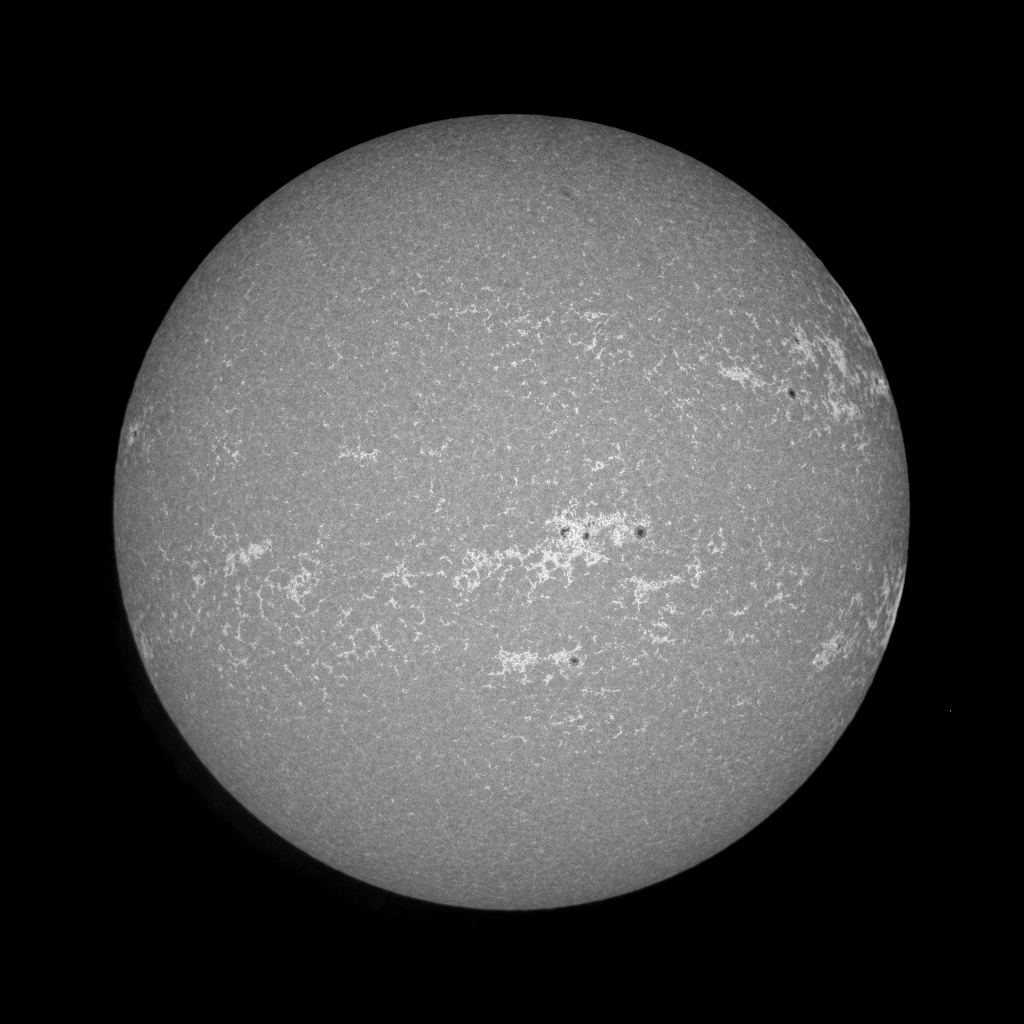
The Sun in Hydrogen-Alpha

Taken using the WYAS Tele-Vue Pronto with Coronado Solar Filters. A 4-Panel mosaic with each panel captured with a QHY5L-II Colour planetary camera running at 30fps @ 1280x960 resolution. Captured in raw SER mode, converted to AVI using PIPP, stacked and wavelet processed in Registax, then assembled in Photoshop.

 06/08/2014

Mars at Opposition


An image of Mars at Opposition, taken from the observatory pad on 15th April 2014. Stacked and processed in Registax6, then colour balanced in PixInsight. Taken with a Celestron 5se scope and a QHY5L-II camera, with a Celestron 2x Barlow.

15/4/2014

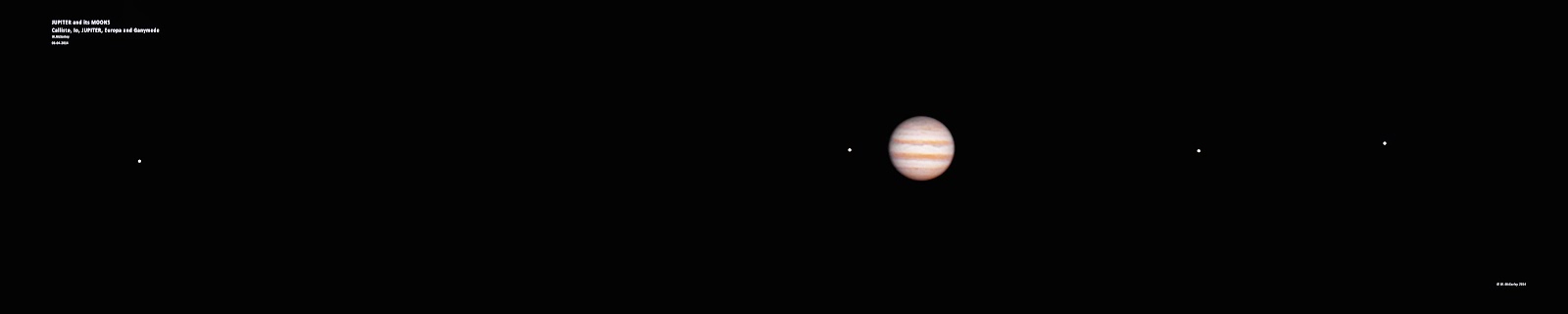
JUPITER and its MOONS


A widefield image of Jupiter and its moons (L to R: Callisto, Io, JUPITER, Europa and Ganymede) taken from the observatory pad. Stacked and processed in Registax6, then colour balanced in PixInsight.

A closeup view of Jupiter and Io.

Both images taken with a Celestron 5se scope and a QHY5L-II camera. A Celestron 2x Barlow was used for the closeup image.

8/4/2014

WYAS Moon Astrophotography Challenge 15th April 2014

As a one off challenge, we set a competition for one night to photgraph the full moon. 

This Full moon image was taken with a DSLR using an 8” SCT telescope. The image is a composite of 2 moon halves, each half being a high definition image made up of a stack of 30 DSLR images taken with 1/60th second exposure at ISO 640 with a Canon 40D.  The two halves were then merged in Photoshop.

Moon 13th March 2014

This image of the Moon taken on Wednesday 13th March 2014 is a mosaic composite image. Taken using a Celestron 8" SCT and a DMK 21AU04 CCD Mono Image camera.

This composite image consists of 74 video .avi files, each of 1000 frames approx. 16 seconds in length. Each video file is processed using RegiStax to create a single .tif image. These single tif images are then assembled in Adobe Photoshop to create the final overall Moon image. 

National Astronomy Week Event 4th March 2014

WYAS held a special opening at the Rosse observatory on March 4th as part of National Astronomy Week.
The theme was “Jupiter and its moons” The event was well attended by the public and club members. We had our 14” SCT in the dome operational, plus our 18”, 10”, 8” scopes and reverse binoculars all in use by the public.
We setup astrophotography on the 8” SCT and took these images during the night of Jupiter with a Phillips SPC800 web cam and Orion using a DSLR with a 40sec exposure at ISO3200.


This is my attempt at imaging the supernova in M82 on the 23rd January 2014. The image was taken through a Televue 102 on a Celestron CGEM mount guided via a Lodestar guider through a separate refractor. 1.25-inch Baader filters were used in an Atik filter wheel. The main camera was an Atik 314L+ controlled through MaximDL. Some images lost to satellites and planes, so 20 mins green, 15 mins blue, 35 mins Luminance and 50 mins hydrogen alpha 35nm. Calibrated and stacked in MaximDL. Final processing done in Photoshop CS6.
This is my first attempt at the Horsehead Nebula in Orion on the 19/1/2014. 15 x 5 minute exposures in Luminance only filter. Telescope was 102mm Televue refractor using an Atik 314L camera cooled to -20C. Guided by a Lodestar guider. Seeing very steady with a hint of mist forming - very icy on the ground.

Messier 33 - Triangulum Galaxy


The Triangulum Galaxy is a spiral galaxy approximately 3 million light years from Earth in the constellation Triangulum. The Triangulum Galaxy is the third-largest member of our Local Group of galaxies, which includes the Milky Way, the Andromeda Galaxy and about 44 other smaller galaxies. It is one of the most distant permanent objects that can be viewed with the naked eye.

25/11/2013
36x300sec Subs, Darks, Flats and Bias

NGC7023 - The Iris Nebula

The Iris Nebula (also known as Caldwell 4) is a bright reflection nebula in the constellation Cepheus. NGC 7023 is actually the cluster within the nebula, with the nebula lit by a magnitude +7 star (SAO 19158) within the cluster. The nubula lies 1,300 light-years away and is approximately six light-years across.

27/11/2013
82x300sec Subs, Darks, Flats and Bias

The North America & Pelican Nebulae

The North America Nebula (NGC 7000) and the nearby Pelican Nebula (IC 5070) are parts of the same interstellar cloud of ionized hydrogen in the constellation Cygnus. The shape of NGC7000 resembles that of the continent of North America, complete with a prominent Gulf of Mexico and the Cygnus's Wall is the term used to describe the Mexico and Central America part of the nebula; this area being the most concentrated star formations area of the whole nebula.
These nebulae are large, covering an area of more than six times the size of the full moon, and it is estimated to be about 1800 light years distance and around 100 light years across. This image is a 3-Panel mosaic covering an area approximately 3° x 2°

27/11/2013
A 3-panel mosaic.
Each Panel: 16x300sec Subs, Darks, Flats and Bias.

Other images from the WYAS 40th Event 23rd November 2013

As part of the open day we had Rocket Launching at the Grange.

Some even get in to orbit !!

and the Planetarium was well supported with programs covering, the Solar System, Galaxy Fly Through and the Space Shuttle / Space Station.

Sun Spots..... WYAS 40th Event 23rd November 2013

Warning.
Never look at the Sun through any Lens based device.  Telescope, Camera, Binoculars, WHY !
Looking at or near the Sun will cause instant and irreversible damage to your eye. Eye damage is often painless, so there is no warning to the observer that damage has occurred until it is too late.  Children should always have adult supervision while observing the sun.  Using special telescopes and filters that remove 99.999% of the harmful light you can observe and image the sun.
This image is a stack of 20 DSLR RAW images, taken using the WYAS Meade 10" SCT telescope with a Thousand Oaks Solar Filter and a Conon 40D. The core images were taken at 1/200 sec @ ISO 400, then stacked in RegiStax 6

Comet ISON Tuesday 19th November 2013

Comet ISON, also known  as C/2012 S1 is a sungrazing comet discovered on 21 September 2012 by Vitali Nevski, and Artyom Novichonok.  Comet ISON’s nucleus is around 5 kilometers (3.1 miles) in diameter. Comet ISON  orbit will come to perihelion (closest approach to the Sun) on 28 November 2013 at a distance of 1,860,000 km; or 1,150,000 miles from the center point of the Sun. Its trajectory appears to be hyperbolic, which suggests that it is a dynamically new comet coming freshly from the Oort Cloud. On its closest approach, Comet ISON will pass about 64,210,000 km; 39,900,000 miles from Earth on 26 December 2013.


Comet ISON/2012 S1 is expected to be brightest around the time it is closest to the Sun; however, it may be less than 1° from the Sun at its closest, making it difficult to see against the Sun's glare. In December, Comet ISON  will be growing dimmer, but, assuming that it remains intact, it will be visible from both hemispheres of Earth, possibly with a long tail. Comet ISON  will be well placed for observers in the northern hemisphere during mid to late December 2013.  After perihelion, it will move north on the celestial sphere, passing within two degrees of Polaris on 8 January.

Half Moon 10th November 2013


This image of the Moon taken on Sunday 10th November 2013 is a mosaic composite image created using HD video images. Taken using a Celestron 8" SCT and a DMK 21AU04 CCD Mono Image camera.


As the imaging sensor on the DMK camera is small, you can only image a small amount of the moon's surface. You take multiple videos of the small area that you can see and create a series of  video files that cover the overall moon's surface. This mosaic of video image files can then be processed and assembled to create the final overall image.


This image consists of 65 video .avi files, each of 2500 frames approx. 40 seconds in length. Each video file is processed using RegiStax to create a single .tif image. These single mosaic images are then assembled in Adobe Photoshop to create the final overall Half Moon image. The effect is a clearer image than that taken by a single DSLR image covering the full DSLR frame.  Open the image and zoom in and to see the depth of the some craters and features on the moon's surface.

Messier 31 - The Andromeda Galaxy

The Andromeda Galaxy (also known as Messier 31 or M31) is a spiral galaxy approximately 2.5 million light-years away in the constellation Andromeda. It is the nearest spiral galaxy to our own Milky Way galaxy and is the largest galaxy of our Local Group, which also contains the Milky Way, the Triangulum Galaxy, and about 30 other smaller galaxies. It is estimated that M31 contains one trillion stars, at least twice the number of stars in our own Milky Way galaxy, which is estimated to be 200–400 billion.

The Andromeda Galaxy is one of the brightest Messier objects, making it visible to the naked eye from a dark site. Although only the brighter central region is visible to the naked eye, when photographed it appears more than six times as wide as the full Moon. This image is a 2-panel mosaic covering an area approximately 2° x 2°.

4/11/2013
A 2-panel mosaic.
Each Panel: 16x300sec Subs, Darks, Flats and Bias.

Star Trails - 4th Nov 2013

This image was originally intended to be a timelapse video of around 500 frames.  However my lens got covered in dew after around 75 shots, so I scrapped that idea (along with 425 shots :( ) and stacked them into a star trail picture instead!

It is a stack of 75 frames, each of which is a 15sec exposure at ISO 800 on my Canon EOS 550D. Long exposure noise reduction was switched on, in the camera settings, to get rid of the dead pixels and also provide a delay between shots. Stacked and tweaked in Photoshop CS5.

The Andromeda galaxy is actually visible as a smudged trail in the top center of the image.

The ET Cluster

The ET Cluster (NGC457) is an open star cluster in the constellation Cassiopeia and lies over 7,900 light years away from the Sun. It has an estimated age of 21 million years. The cluster is often referred to as The ET Cluster (due to its resemblance to the movie character), or The Owl Cluster. The two bright stars, magnitude 5 Phi-1 Cassiopeiae and magnitude 7 Phi-2 Cassiopeiae can be imagined as the eyes.

30/10/2013
9x300sec Subs, Darks, Flats and Bias

The Elephant's Trunk Nebula

The Elephant's Trunk is a concentration of interstellar gas and dust within the much larger ionized gas region IC 1396 located in the constellation Cepheus, about 2,400 light years away from Earth. The nebula is now thought to be a site of star formation, containing several very young stars (less than 100,000 years old) that were discovered in infrared images in 2003.

30/10/2013
25x300sec Subs, Darks, Flats and Bias

The Harvest Moon

This is a composite image. The Luminance data was captured with a QHY5L-ll planetary camera and the colour was captured by a QHY8L OSC camera. The luminance was a stack of 500 frames all stacked in Registax, whilst the colour was a stack of 64 individual images. The moon has very little colour so the colour data is enhanced sinificantly in order to show the subtle hues.

18/9/2013

Witch's Broom & Pickering's Triangle

These nebulae are part of a much bigger nebula called the Veila Super Nova Remnant. It is a cloud of heated and ionized gas and dust in Cygnus and constitutes the visible portions of the Cygnus Loop. The source supernova exploded some 5,000 to 8,000 years ago, and the remnants have since expanded to cover an area roughly 3 degrees in diameter (about 6 times the diameter, or 36 times the area, of the full moon).

7/9/2013
25x300sec Subs, Darks, Flats and Bias

M27 Dumbbel Nebula

The Dumbbell Nebula known as M27, is a planetary nebula in the constellation Vulpecula at a distance of about 1,360 light years from Earth. This image was taken at a WYAS open night on 2nd September 2013. This was taken using my 8" Celestron U2K SCT scope guided with a Canon 40D DSLR. This image is a stack of the best 26 images taken with a 180sec exposure at ISO 800. This image has an overall combined exposure of 78 minutes approx. Images taken in RAW were stacked using Deep Sky Stacker software to create a composite image with final image processing done in Photoshop CS6 with the aid of B McSorley.

Alberio

My first attempt at Alberio this year , using synscan goto mount with a small scope , cannon 1100d .
It is a stack of 5 15 second exposures .

Sun Spots (June 4th Club Night)

Warning.
Never look at the Sun through any Lens based device.  Telescope, Camera, Binoculars, WHY !
Looking at or near the Sun will cause instant and irreversible damage to your eye. Eye damage is often painless, so there is no warning to the observer that damage has occurred until it is too late.  Children should always have adult supervision while observing the sun.  If the above is the case, how do we photograph sun spots, prominences, partial / total solar eclipses ??? , by using special telescopes and filters that remove 99.999% of the harmful light thus allowing visual observation and images to be taken.
The above said, here are two images taken using an 8" SCT telescope with a Thousand Oaks Solar Filter and a normal DSLR. You can clearly see the sun spots. The images shown are stacks of 20 individual DSLR images, stacked to give the composite. The upper images were taken at 1/400 sec @ ISO 800, the lower image are 1/125 sec @ ISO 1000

M81 & M82 - Bode's and Cigar Galaxies

M81 (also known as Bode's Galaxy) is a spiral galaxy about 12 million light-years away in the constellation Ursa Major. Its companion, M82 (also known as the Cigar Galaxy) is a nearby starburst galaxy also about 12 million light-years away.

13/3/2013
20x300sec Subs, Darks, Flats and Bias.